As I only track in English what people are giving up, there are concentrations in English-speaking countries.
Size indicates the relative number of Twitterers in each country giving up something for Lent.
Categories of Things Given up by State
These visualizations show the differences (or lack thereof) in what people are giving up among U.S. states.
Size indicates the relative number of Twitterers in each state giving up something for Lent. Sorry, Alaska and Hawaii.
The composition of each state’s categories of tweets shows mostly minor variations among states. Some states (like Wyoming on the far right) have small numbers of tweets. I would have liked to use opacity or width to indicate this disparity but couldn’t figure out how to do it.
Comparison between 2009 and 2010
This treemap shows how the data changed between 2009 and 2010. The size of the box shows the number of people giving up each category and thing, while color indicates the percentage change from last year: dark blue indicates the steepest drop; dark orange indicates the steepest rise. The second chart shows the same data more conventionally expressed.
About the Visualizations
I created these charts mostly to explore how the new data-analysis software Tableau Public works. One of its claims to fame is that you can publish interactive visualizations to the web, a feature I didn’t take advantage of here. Tableau doesn’t do treemaps, so I used Many Eyes to create the treemap; the closest Tableau equivalent appears below the treemap.
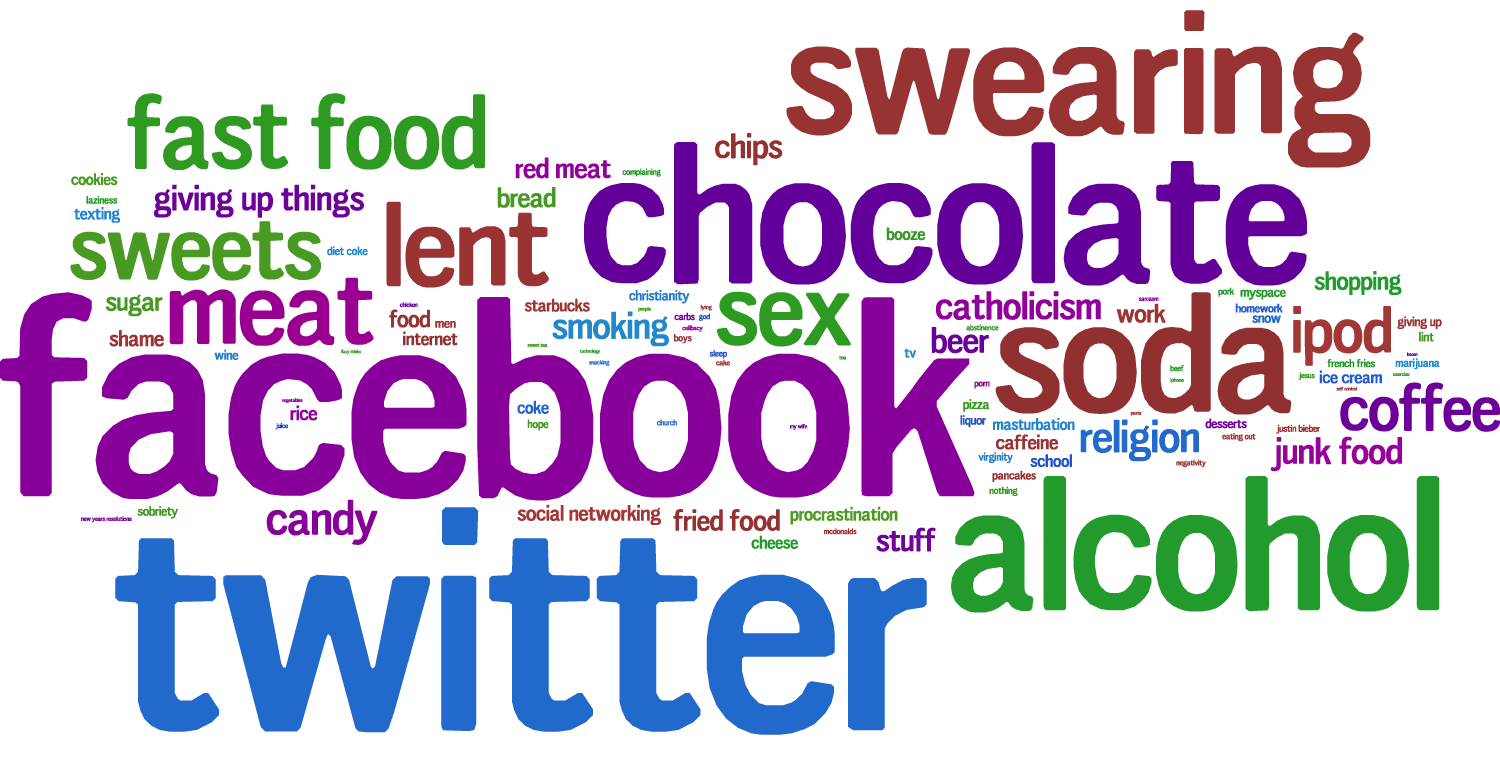
Snow makes the list this year, understandable given the Snowpocalypse and Snowmageddon that gripped much of the Eastern U.S. in the weeks preceding Ash Wednesday. IPods also made the list after the Bishop of Liverpool asked people to consider praying instead of listening to them. This year a celebrity, Justin Bieber, cracks the top 100. He beat out the Jonas Brothers, 64 votes to 11; draw your own conclusions.
The list largely tracks last year’s list. It draws from 40,000 tweets retrieved February 14-20, 2010.
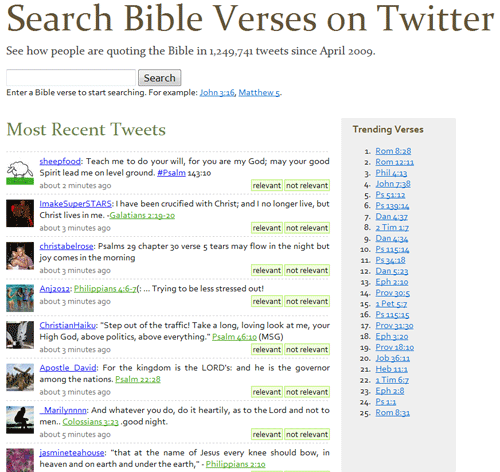
Search over 1.2 million Bible verses on Twitter–nearly every tweet that has mentioned a Bible verse since April 2009. You can also see a list of the most popular verses on Twitter over the past few hours (“Trending Verses”).
This project uses several APIs from Twitter and is still in a beta stage. It could evolve in several directions, but I want to see how people use it before developing it further.
It’s not quite realtime, but the most recent tweet is rarely more than a few minutes old.
Behind the scenes, it processes tweets to try to ensure their relevance; it has about a 92% accuracy rate based on a training corpus of around 45,000 tweets. Use the “relevant” and “not relevant” buttons in the interface if you see a tweet that you think should or shouldn’t belong. (I’m mostly interested in the latter, but it seems weird not to have both–like Facebook’s lack of an unlike button.)
It currently uses Logos RefTagger to link the Bible references in the tweets.
Feel free to leave a comment here if you have a feature idea or want to make any suggestions.
Edit February 2016: This feature is no longer available; with over 200 million tweets, it’s just too much data to serve reliably. Instead, the latest tweets are visible.
When people tweet about Bible verses on Twitter, what words do they use? Here are the top 100:
bible
lord
christ
gospel
psalm
god
psalms
corinthians
preach
shall
heaven
readings
church
spirit
righteous
verse
lectionary
verses
spiritual
ministry
pray
enemies
thou
tongue
creation
wisdom
deuteronomy
testament
strength
refuge
therefore
kingdom
romans
holy
thankful
thy
reading
rejoice
understanding
faithful
message
earth
blessed
exodus
deut
faith
wise
beginning
pastor
chapel
chapter
survey
anger
resurrection
risen
read
hearts
chronicles
salvation
flesh
servant
glory
praying
kings
sheep
praise
trust
prosperity
bless
heavens
deeds
toward
discussion
whoever
speaks
ye
hath
amen
teaching
thess
apostles
preparing
eph
eccl
path
fear
upon
presence
inspire
search
zechariah
seek
teach
wrath
commandments
believers
humility
spoke
thee
devo
Background
Extracting Bible references from text means identifying whether a given piece of text is referring to a Bible verse or something else. For example, the meaning of Acts 2 depends on context:
Referring to Bible passage:Acts 2 recounts the early church.
Not referring to Bible passage: She’s 5 years old but acts 2.
When you encounter a phrase that could be a Bible reference, you have to look at context to determine whether the phrase is a Bible reference. Humans can make this leap pretty easily, but computers need rigorous models and lots of training data to guess whether an ambiguous phrase is a Bible reference. In the above example, the phrase “early church” is a strong indicator that the phrase “Acts 2” is a Bible reference, while the phrase “years old” is an indicator the other way.
Twitter, with its high volume of content and decent search engine, provides lots of training data.
Methodology
Using the Twitter Search API, I downloaded 30,000 tweets possibly containing Bible references (e.g., [john 3], [jeremiah 29]) and then categorized them by hand as referring to a Bible verse or not.
I then ran a Naive Bayes algorithm on the resulting tweets to produce the above list, which contains the words that most strongly indicate the presence of a Bible reference.
This list suffers from sample bias, of course: a different set of tweets would produce a different list. In addition, the list is Twitter-centric; the results may not carry over into blogs or other media. (People substitute the number “2” for the word “to” and “4” for “for” on Twitter more frequently than they do elsewhere, for example, which oversamples content like “I’m meeting Matthew 4 dinner.”)
See It in Action
Search for Bible references on Twitter. Use the relevant and not relevant buttons to improve the filtering. I haven’t formally announced this new feature of OpenBible.info yet; consider the link a preview.
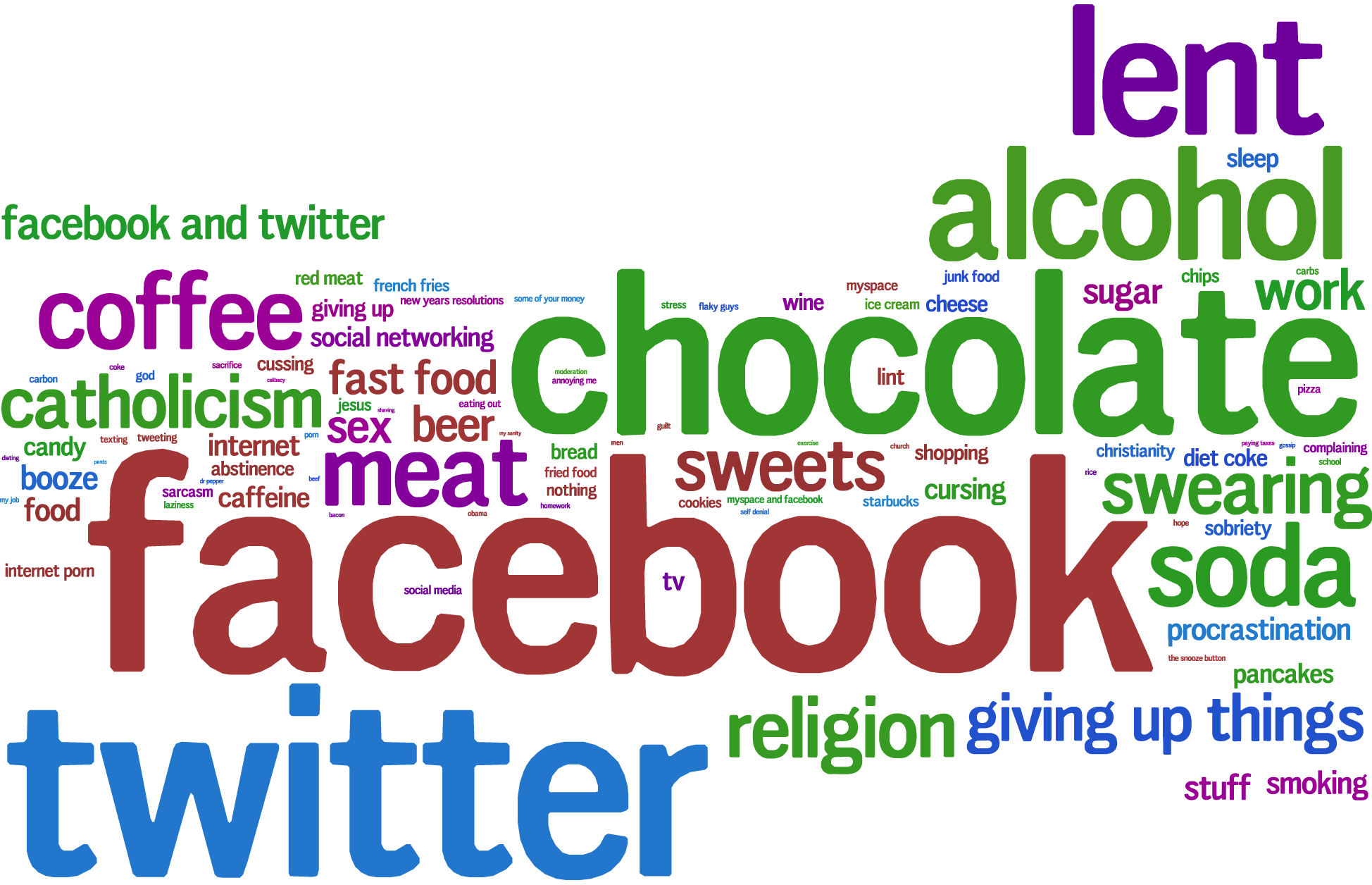
Some you’d expect (alcohol, chocolate), some are ironic (giving up Lent for Lent, giving up giving up things), some are odd (pants, lint), some are anti-religious (religion, Catholicism), and some are tech-related (Facebook, Twitter—even “Facebook and Twitter” makes the list).
Complete List
Facebook (654)
Twitter (317)
Chocolate (272)
Lent (216)
Alcohol (187)
Soda (139)
Coffee (129)
Meat (126)
Religion (102)
Swearing (94)
Sweets (92)
Catholicism (90)
Giving up things (80)
Work (70)
Beer (60)
Sex (59)
Fast food (57)
Facebook and twitter (57)
Sugar (45)
Stuff (43)
Booze (41)
Smoking (39)
Food (39)
Procrastination (38)
Internet (37)
Cursing (36)
Caffeine (35)
TV (33)
Pancakes (33)
Social networking (33)
Sleep (32)
Candy (32)
Diet Coke (29)
Giving up (29)
You (28)
Wine (28)
Lint (28)
Cheese (28)
Bread (26)
Shopping (26)
Sobriety (26)
Abstinence (24)
Cussing (24)
Red meat (24)
Chips (23)
Internet porn (22)
Christianity (22)
Nothing (21)
French fries (21)
Jesus (21)
Sarcasm (19)
Junk food (19)
Starbucks (18)
Ice cream (18)
MySpace (18)
Cookies (18)
Fried food (17)
Complaining (17)
God (16)
New years resolutions (15)
Social media (15)
Pizza (14)
Tweeting (14)
Carbs (13)
MySpace and Facebook (13)
Carbon (13)
Eating out (13)
Stress (13)
Flaky guys (12)
Laziness (12)
Texting (12)
Me (11)
Some of your money (11)
Annoying me (11)
Sacrifice (11)
School (11)
Hope (10)
Rice (10)
Coke (10)
Porn (10)
The snooze button (10)
Guilt (10)
Men (9)
Obama (9)
Church (9)
My job (9)
Homework (9)
Self denial (9)
Moderation (9)
Exercise (8)
Bacon (8)
Dieting (8)
Paying taxes (8)
Dr Pepper (8)
Gossip (8)
Beef (8)
Pants (7)
My sanity (7)
Celibacy (7)
Shaving (7)
About
Created using the Twitter Search API and Wordle. Data based on analysis of 15,000 tweets from February 22-26, 2009.
 Size indicates the relative number of Twitterers in each country giving up something for Lent.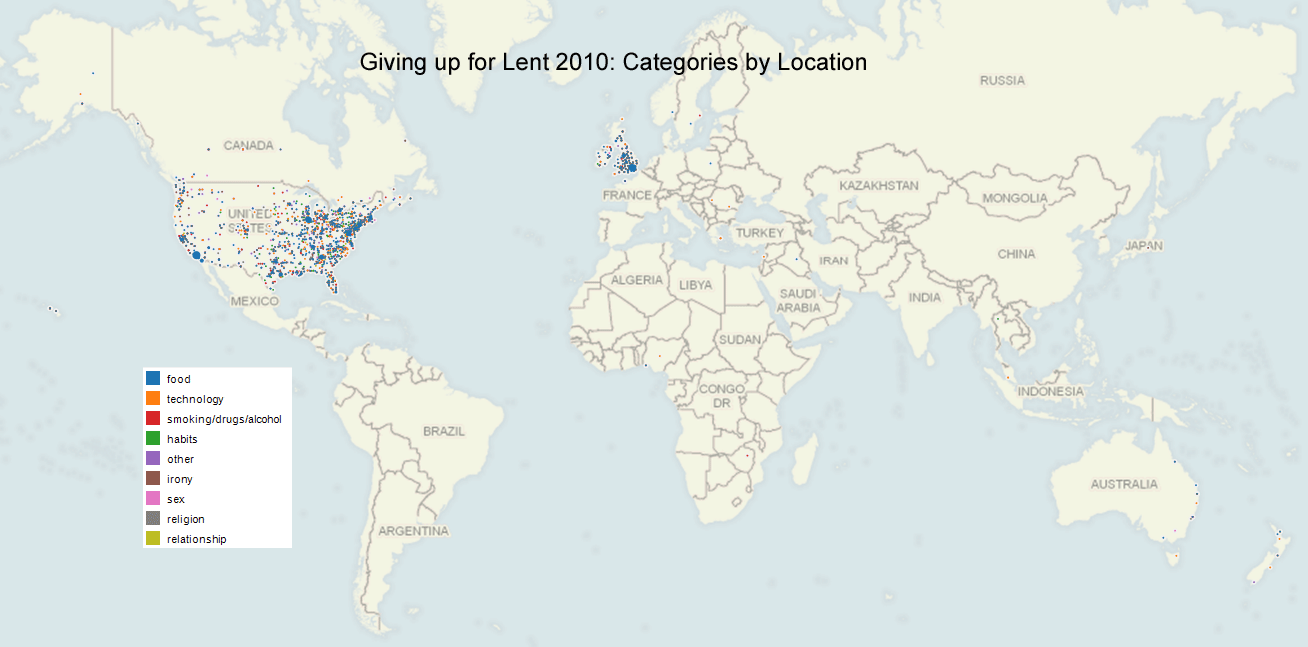
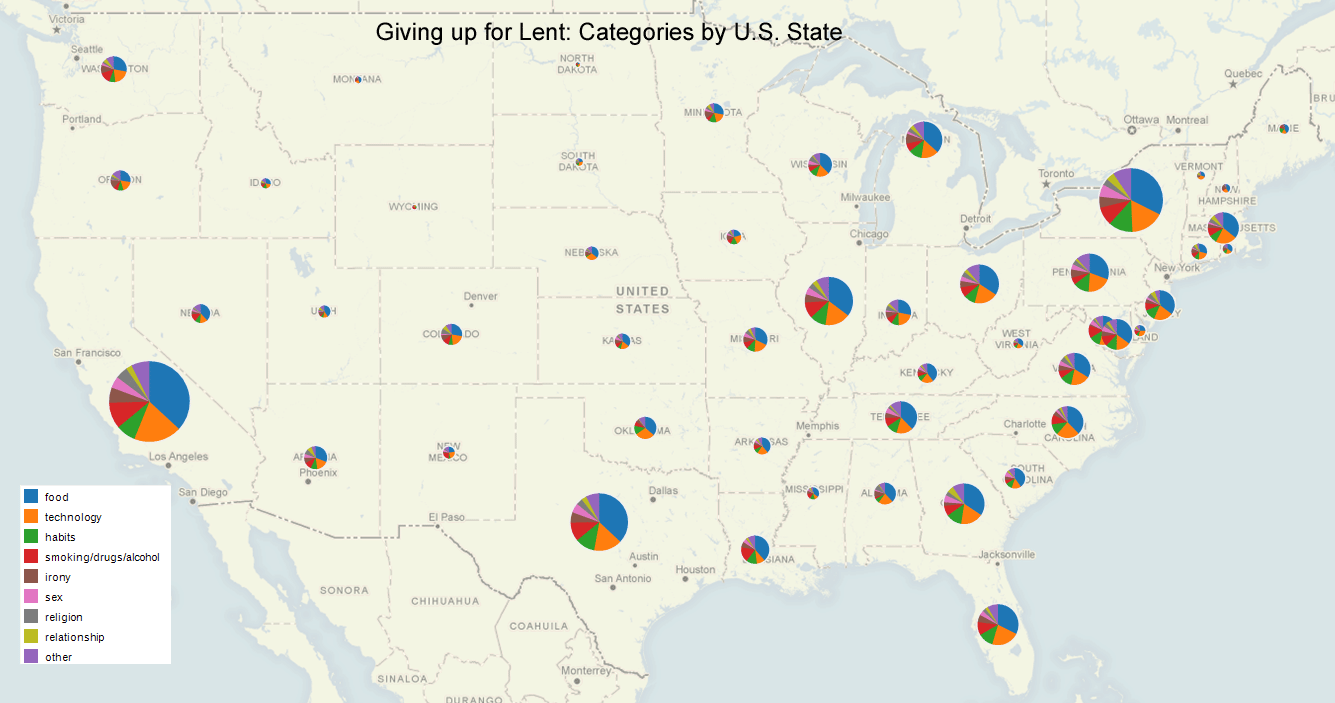 Size indicates the relative number of Twitterers in each state giving up something for Lent. Sorry, Alaska and Hawaii.
 The composition of each state’s categories of tweets shows mostly minor variations among states. Some states (like Wyoming on the far right) have small numbers of tweets. I would have liked to use opacity or width to indicate this disparity but couldn’t figure out how to do it.